
Open History to see the last commit

1---
2id: reading-and-writing-file
3title: Building a Full Stack DevJokes App with TanStack Start
4redirect_from:
5 - /framework/solid/guide/reading-writing-file
6---
7
8This tutorial will guide you through building a complete full-stack application using TanStack Start. You'll create a DevJokes app where users can view and add developer-themed jokes, demonstrating key concepts of TanStack Start including server functions, file-based data storage, and Solid components.
9
10Here's a demo of the app in action:
11
12<iframe width="560" height="315" src="https://www.youtube.com/embed/zd0rtKbtlgU?si=7W1Peoo0W0WvZmAd" title="YouTube video player" frameborder="0" allow="accelerometer; autoplay; clipboard-write; encrypted-media; gyroscope; picture-in-picture; web-share" referrerpolicy="strict-origin-when-cross-origin" allowfullscreen></iframe>
13
14The complete code for this tutorial is available on [GitHub](https://github.com/shrutikapoor08/devjokes).
15
16## What You'll Learn
17
18Setting up a TanStack Start project
19Implementing server functions
20Reading and writing data to files
21Building a complete UI with Solid components
22Using TanStack Router for data fetching and navigation
23
24## Prerequisites
25
26Basic knowledge of Solid and TypeScript.
27Node.js and `pnpm` installed on your machine
28
29## Nice to know
30
31[Server Side Rendering (SSR)](/router/latest/docs/framework/solid/guide/ssr)
32[TanStack Router concepts](/router/latest/docs/framework/solid/routing/routing-concepts)
33[Solid Query concepts](/query/latest/docs/framework/solid/overview)
34
35## Setting up a TanStack Start Project
36
37First, let's create a new TanStack Start project:
38
40pnpx @tanstack/cli@latest create --framework solid devjokes
41cd devjokes
43
44When this script runs, it will ask you a few setup questions. You can either pick choices that work for you or just press enter to accept the defaults.
45
46Optionally, you can pass in a `--add-on` flag to get options such as Shadcn, Clerk, Convex, TanStack Query, etc.
47
48Once setup is complete, install dependencies and start the development server:
49
51pnpm i
52pnpm dev
54
55For this project, we'll need the `uuid` package:
56
58# Install uuid for generating unique IDs
59pnpm add uuid
61
62## Understanding the project structure
63
64At this point, the project structure should look like this -
65
68├── src/
69│ ├── routes/
70│ │ ├── demo/ # Demo routes
71│ │ ├── __root.tsx # Root layout
72│ │ └── index.tsx # Home page
73│ ├── components/ # Solid components
74│ ├── data/ # Data files
75│ ├── router.tsx # Router configuration
76│ ├── routeTree.gen.ts # Generated route tree
77│ └── styles.css # Global styles
78├── public/ # Static assets
79├── vite.config.ts or rsbuild.config.ts # TanStack Start configuration
80├── package.json # Project dependencies
81└── tsconfig.json # TypeScript configuration
83
84This structure might seem overwhelming at first, but here are the key files you need to focus on:
85
86`src/router.tsx` - Sets up routing for your application
87`src/routes/__root.tsx` - The root layout component where you can add global styles and components
88`src/routes/index.tsx` - Your home page
89
90Once your project is set up, you can access your app at `localhost:3000`. You should see the default TanStack Start welcome page.
91
92At this point, your app will look like this:
93
94
95
96## Step 1: Reading Data From a File
97
98Let's start by creating a file-based storage system for our jokes.
99
100### Step 1.1: Create a JSON File with Jokes
101
102Let's set up a list of jokes that we can use to render on the page. Create a `jokes.json` file within `src/data`:
103
105touch src/data/jokes.json
107
108Now, let's add some sample jokes to this file:
109
111[
112 {
113 "id": "1",
114 "question": "Why don't keyboards sleep?",
115 "answer": "Because they have two shifts"
116 },
117 {
118 "id": "2",
119 "question": "Are you a RESTful API?",
120 "answer": "Because you GET my attention, PUT some love, POST the cutest smile, and DELETE my bad day"
121 },
122 {
123 "id": "3",
124 "question": "I used to know a joke about Java",
125 "answer": "But I ran out of memory."
126 },
127 {
128 "id": "4",
129 "question": "Why do Front-End Developers eat lunch alone?",
130 "answer": "Because, they don't know how to join tables."
131 },
132 {
133 "id": "5",
134 "question": "I am declaring a war.",
135 "answer": "var war;"
136 }
137]
139
140### Step 1.2: Create Types for Our Data
141
142Let's create a file to define our data types. Create a new file at `src/types/index.ts`:
143
145// src/types/index.ts
146export interface Joke {
147 id: string
148 question: string
149 answer: string
150}
151
152export type JokesData = Joke[]
154
155### Step 1.3: Create Server Functions to Read the File
156
157Let's create a new file `src/serverActions/jokesActions.ts` to create a server function to perform a read-write operation. We will be creating a server function using [`createServerFn`](https://tanstack.com/start/latest/docs/framework/solid/guide/server-functions).
158
160// src/serverActions/jokesActions.ts
161import { createServerFn } from '@tanstack/solid-start'
162import * as fs from 'node:fs'
163import type { JokesData } from '../types'
164
165const JOKES_FILE = 'src/data/jokes.json'
166
167export const getJokes = createServerFn({ method: 'GET' }).handler(async () => {
168 const jokes = await fs.promises.readFile(JOKES_FILE, 'utf-8')
169 return JSON.parse(jokes) as JokesData
170})
172
173In this code, we are using `createServerFn` to create a server function that reads the jokes from the JSON file. The `handler` function is where we are using the `fs` module to read the file.
174
175### Step 1.4: Consume Server Function on the Client Side
176
177Now to consume this server function, we can simply call it in our code using TanStack Router which already comes with TanStack Start!
178
179Now let's create a new component `JokesList` to render the jokes on the page with a little Tailwind styling sprinkle.
180
182// src/components/JokesList.tsx
183import { Joke } from '../types'
184
185interface JokesListProps {
186 jokes: Joke[]
187}
188
189export function JokesList({ jokes }: JokesListProps) {
190 if (!jokes || jokes.length === 0) {
191 return <p class="text-gray-500 italic">No jokes found. Add some!</p>
192 }
193
194 return (
195 <div class="space-y-4">
196 <h2 class="text-xl font-semibold">Jokes Collection</h2>
197 {jokes.map((joke) => (
198 <div
199 key={joke.id}
200 class="bg-white p-4 rounded-lg shadow-md border border-gray-200"
201 >
202 <p class="font-bold text-lg mb-2">{joke.question}</p>
203 <p class="text-gray-700">{joke.answer}</p>
204 </div>
205 ))}
206 </div>
207 )
208}
210
211Now let's call our server function inside `index.tsx` using TanStack Router which already comes with TanStack Start!
212
214// src/routes/index.tsx
215import { createFileRoute } from '@tanstack/solid-router'
216import { getJokes } from './serverActions/jokesActions'
217import { JokesList } from './JokesList'
218
219export const Route = createFileRoute('/')({
220 loader: async () => {
221 // Load jokes data when the route is accessed
222 return getJokes()
223 },
224 component: App,
225})
226
227const App = () => {
228 const jokes = Route.useLoaderData() || []
229
230 return (
231 <div class="max-w-2xl mx-auto py-12 px-4 space-y-6">
232 <h1 class="text-4xl font-bold text-center mb-10">DevJokes</h1>
233 <JokesList jokes={jokes} />
234 </div>
235 )
236}
238
239When the page loads, `jokes` will have data from the `jokes.json` file already!
240
241With a little Tailwind styling, the app should look like this:
242
243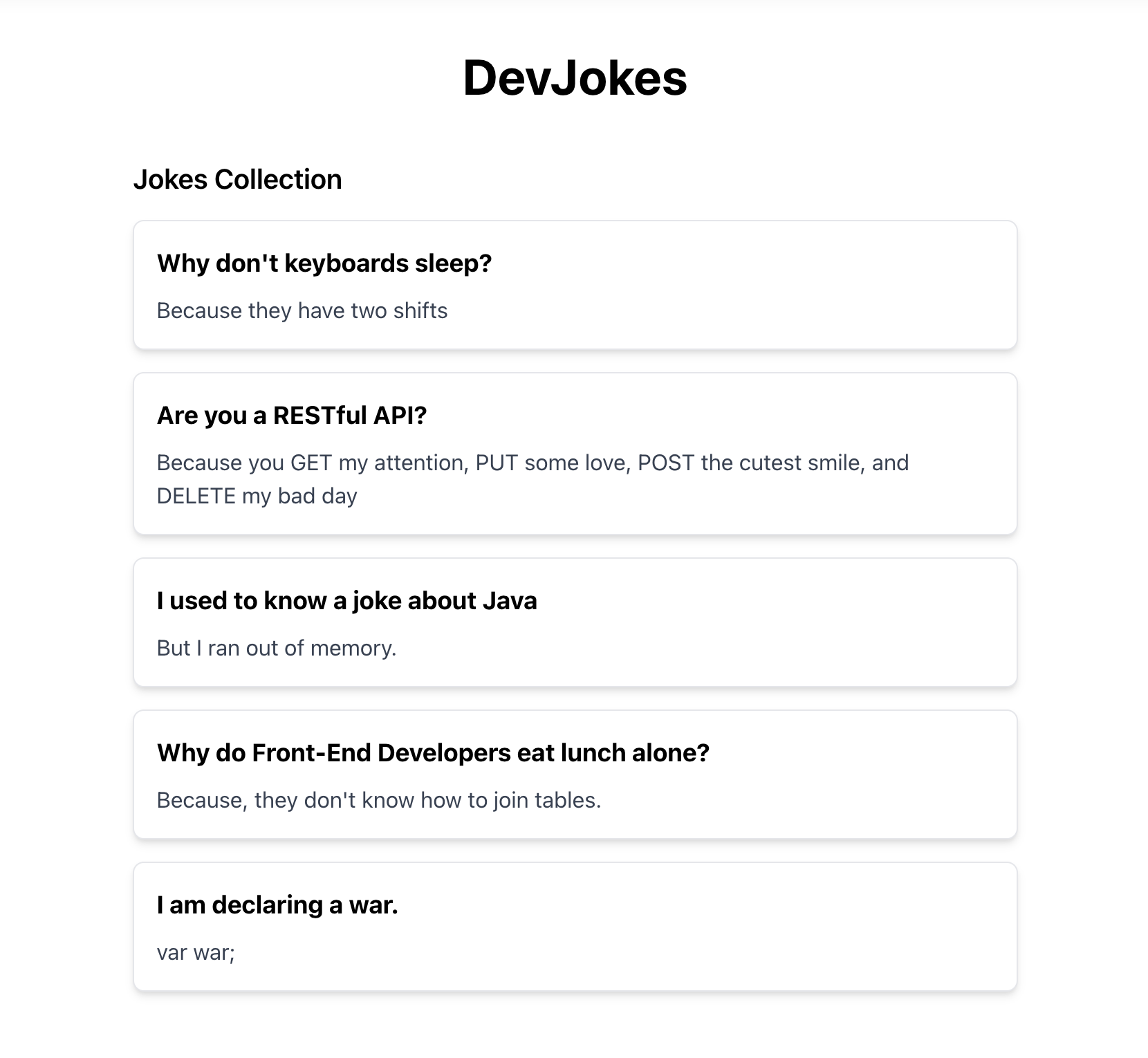
244
245## Step 2: Writing Data to a File
246
247So far, we have been able to read from the file successfully! We can use the same approach to write to the `jokes.json` file using `createServerFunction`.
248
249### Step 2.1: Create Server Function to Write to the File
250
251It's time to modify the `jokes.json` file so that we can add new jokes to it. Let's create another server function but this time with a `POST` method to write to the same file.
252
254// src/serverActions/jokesActions.ts
255import { createServerFn } from '@tanstack/solid-start'
256import * as fs from 'node:fs'
257import { v4 as uuidv4 } from 'uuid' // Add this import
258import type { Joke, JokesData } from '../types'
259
260const JOKES_FILE = 'src/data/jokes.json'
261
262export const getJokes = createServerFn({ method: 'GET' }).handler(async () => {
263 const jokes = await fs.promises.readFile(JOKES_FILE, 'utf-8')
264 return JSON.parse(jokes) as JokesData
265})
266
267// Add this new server function
268export const addJoke = createServerFn({ method: 'POST' })
269 .validator((data: { question: string; answer: string }) => {
270 // Validate input data
271 if (!data.question || !data.question.trim()) {
272 throw new Error('Joke question is required')
273 }
274 if (!data.answer || !data.answer.trim()) {
275 throw new Error('Joke answer is required')
276 }
277 return data
278 })
279 .handler(async ({ data }) => {
280 try {
281 // Read the existing jokes from the file
282 const jokesData = await getJokes()
283
284 // Create a new joke with a unique ID
285 const newJoke: Joke = {
286 id: uuidv4(),
287 question: data.question,
288 answer: data.answer,
289 }
290
291 // Add the new joke to the list
292 const updatedJokes = [...jokesData, newJoke]
293
294 // Write the updated jokes back to the file
295 await fs.promises.writeFile(
296 JOKES_FILE,
297 JSON.stringify(updatedJokes, null, 2),
298 'utf-8',
299 )
300
301 return newJoke
302 } catch (error) {
303 console.error('Failed to add joke:', error)
304 throw new Error('Failed to add joke')
305 }
306 })
308
309In this code:
310
311We are using `createServerFn` to create server functions that run on the server but can be called from the client. This server function is used to write data to the file.
312We are going to first use `validator` to validate the input data. This is a good practice to ensure that the data we are receiving is in the correct format.
313We are going to perform the actual write operation in the `handler` function.
314`getJokes` reads the jokes from our JSON file.
315`addJoke` validates the input data and adds a new joke to our file.
316We're using `uuidv4()` to generate unique IDs for our jokes.
317
318### Step 2.2: Adding a Form to Add Jokes to our JSON File
319
320Now, let's modify our home page to display jokes and provide a form to add new ones. Let's create a new component called `JokeForm.jsx` and add the following form to it:
321
323// src/components/JokeForm.tsx
324import { createSignal } from 'solid'
325import { useRouter } from '@tanstack/solid-router'
326import { addJoke } from '../serverActions/jokesActions'
327
328export function JokeForm() {
329 const router = useRouter()
330 const [question, setQuestion] = createSignal('')
331 const [answer, setAnswer] = createSignal('')
332 const [isSubmitting, setIsSubmitting] = createSignal(false)
333 const [error, setError] = createSignal<string | null>(null)
334
335 return (
336 <form onSubmit={handleSubmit} class="mb-8">
337 {error && (
338 <div class="bg-red-100 text-red-700 p-2 rounded mb-4">{error}</div>
339 )}
340
341 <div class="flex flex-col sm:flex-row gap-4 mb-8">
342 <input
343 id="question"
344 type="text"
345 placeholder="Enter joke question"
346 class="w-full p-2 border rounded focus:ring focus:ring-blue-300 flex-1"
347 value={question()}
348 onChange={(e) => setQuestion(e.target.value)}
349 required
350 />
351
352 <input
353 id="answer"
354 type="text"
355 placeholder="Enter joke answer"
356 class="w-full p-2 border rounded focus:ring focus:ring-blue-300 flex-1 py-4"
357 value={answer()}
358 onChange={(e) => setAnswer(e.target.value)}
359 required
360 />
361
362 <button
363 type="submit"
364 disabled={isSubmitting()}
365 class="bg-blue-500 hover:bg-blue-600 text-white font-medium rounded disabled:opacity-50 px-4"
366 >
367 {isSubmitting() ? 'Adding...' : 'Add Joke'}
368 </button>
369 </div>
370 </form>
371 )
372}
374
375### Step 2.3: Wire Up the Form to the Server Function
376
377Now, let's wire the form up to our `addJoke` server function in the `handleSubmit` function. Calling a server action is simple! It's just a function call.
378
380//JokeForm.tsx
381import { createSignal } from 'solid'
382import { useRouter } from '@tanstack/solid-router'
383import { addJoke } from '../serverActions/jokesActions'
384
385export function JokeForm() {
386 const router = useRouter()
387 const [question, setQuestion] = createSignal('')
388 const [answer, setAnswer] = createSignal('')
389 const [isSubmitting, setIsSubmitting] = createSignal(false)
390 const [error, setError] = createSignal<string | null>(null)
391
392 const handleSubmit = async () => {
393 if (!question() || !answer() || isSubmitting()) return
394 try {
395 setIsSubmitting(true)
396 await addJoke({
397 data: { question(), answer() },
398 })
399
400 // Clear form
401 setQuestion('')
402 setAnswer('')
403
404 // Refresh data
405 router.invalidate()
406 } catch (error) {
407 console.error('Failed to add joke:', error)
408 setError('Failed to add joke')
409 } finally {
410 setIsSubmitting(false)
411 }
412 }
413
414 return (
415 <form onSubmit={handleSubmit} class="mb-8">
416 {error && (
417 <div class="bg-red-100 text-red-700 p-2 rounded mb-4">{error}</div>
418 )}
419 <div class="flex flex-col sm:flex-row gap-4 mb-8">
420 <input
421 id="question"
422 type="text"
423 placeholder="Enter joke question"
424 class="w-full p-2 border rounded focus:ring focus:ring-blue-300 flex-1"
425 value={question()}
426 onChange={(e) => setQuestion(e.target.value)}
427 required
428 />
429 <input
430 id="answer"
431 type="text"
432 placeholder="Enter joke answer"
433 class="w-full p-2 border rounded focus:ring focus:ring-blue-300 flex-1 py-4"
434 value={answer()}
435 onChange={(e) => setAnswer(e.target.value)}
436 required
437 />
438 <button
439 type="submit"
440 disabled={isSubmitting()}
441 class="bg-blue-500 hover:bg-blue-600 text-white font-medium rounded disabled:opacity-50 px-4"
442 >
443 {isSubmitting() ? 'Adding...' : 'Add Joke'}
444 </button>
445 </div>
446 </form>
447 )
448}
450
451With this, our UI should look like this:
452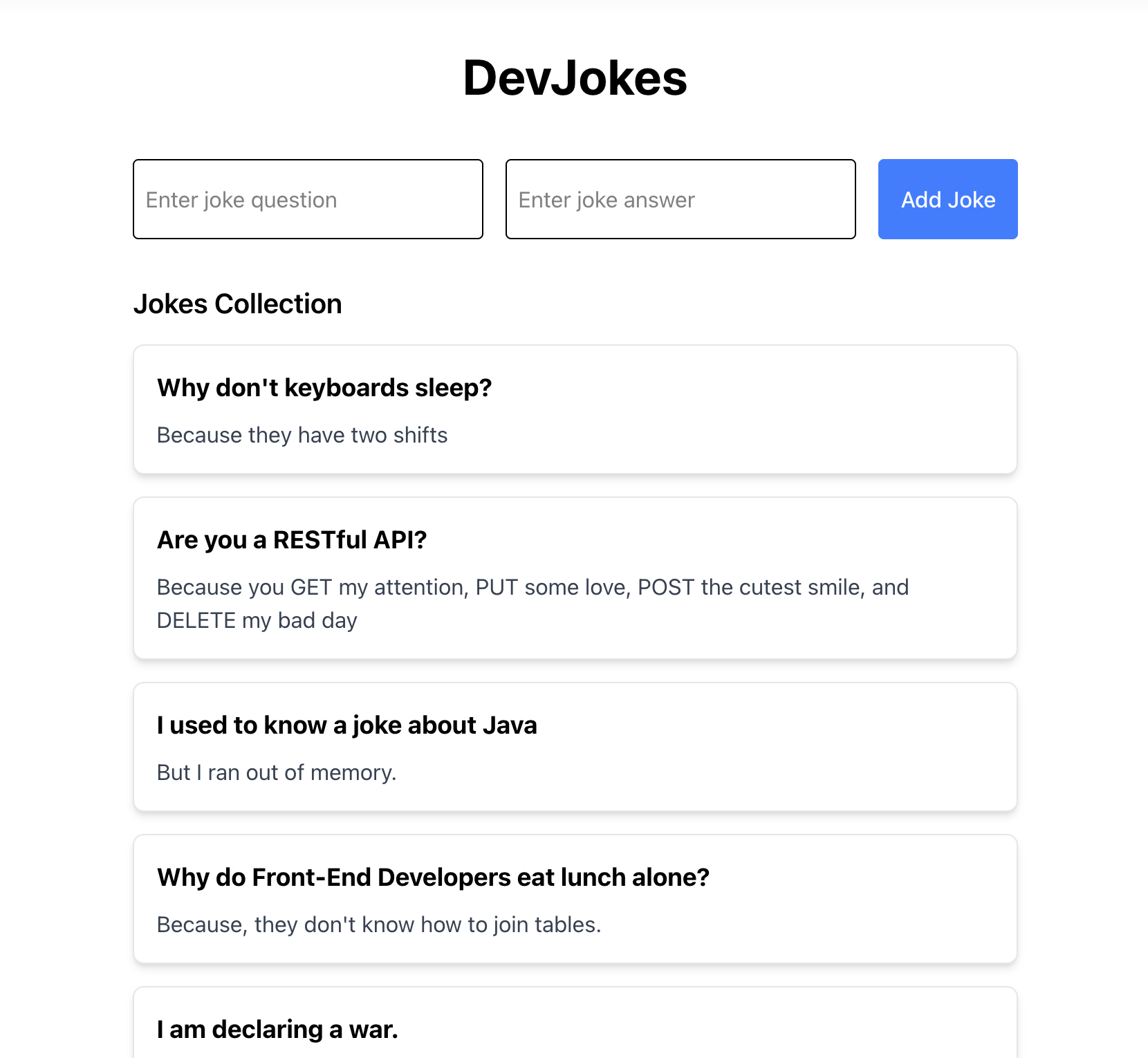
453
454## Understanding How It All Works Together
455
456Let's break down how the different parts of our application work together:
457
458**Server Functions**: These run on the server and handle data operations
459`getJokes`: Reads the jokes from our JSON file
460`addJoke`: Adds a new joke to our JSON file
461
462**TanStack Router**: Handles routing and data loading
463The loader function fetches jokes data when the route is accessed
464`useLoaderData` makes this data available in our component
465`router.invalidate()` refreshes the data when we add a new joke
466
467**Solid Components**: Build the UI of our application
468`JokesList`: Displays the list of jokes
469`JokeForm`: Provides a form for adding new jokes
470
471**File-Based Storage**: Stores our jokes in a JSON file
472Reading and writing are handled by Node.js `fs` module
473Data is persisted between server restarts
474
475## How Data Flows Through the Application
476
477### Data Flow
478
480sequenceDiagram
481autonumber
482actor User
483participant UI as Browser (HomePage + Form)
484participant Loader as Route Loader (loader)
485participant Server
486participant Store as jokes.json
487
488%% Visiting the Home Page
489User ->> UI: Visit /
490UI ->> Loader: loader() calls getJokes()
491Loader ->> Server: getJokes()
492Server ->> Store: Read jokes.json
493Store -->> Server: jokes data
494Server -->> Loader: jokes[]
495Loader -->> UI: useLoaderData() → jokes[]
496
497%% Adding a New Joke
498User ->> UI: Fill form and submit
499UI ->> Server: handleSubmit → addJoke(newJoke)
500Server ->> Store: Read jokes.json
501Server ->> Store: Write updated jokes.json
502Server -->> UI: addJoke() resolved
503UI ->> Loader: router.invalidate() (re-run loader)
504Loader ->> Server: getJokes()
505Server ->> Store: Read jokes.json
506Store -->> Server: updated jokes[]
507Server -->> Loader: updated jokes[]
508Loader -->> UI: useLoaderData() → updated jokes[]
510
511When a user visits the home page:
512
513The `loader` function in the route calls `getJokes()` server function
514The server reads `jokes.json` and returns the jokes data
515This data is passed to the `HomePage` component through `useLoaderData()`
516The `HomePage` component passes the data to the `JokesList` component
517
518When a user adds a new joke:
519
520They fill out the form and submit it
521The `handleSubmit` function calls the `addJoke()` server function
522The server reads the current jokes, adds the new joke, and writes the updated data back to `jokes.json`
523After the operation completes, we call `router.invalidate()` to refresh the data
524This triggers the loader again, fetching the updated jokes
525The UI updates to show the new joke in the list
526
527Here's a demo of the app in action:
528
529<iframe width="560" height="315" src="https://www.youtube.com/embed/zd0rtKbtlgU?si=7W1Peoo0W0WvZmAd" title="YouTube video player" frameborder="0" allow="accelerometer; autoplay; clipboard-write; encrypted-media; gyroscope; picture-in-picture; web-share" referrerpolicy="strict-origin-when-cross-origin" allowfullscreen></iframe>
530
531## Common Issues and Debugging
532
533Here are some common issues you might encounter when building your TanStack Start application and how to resolve them:
534
535### Server Functions Not Working
536
537If your server functions aren't working as expected:
538
539Check that you're using the correct HTTP method (`GET`, `POST`, etc.)
540Ensure file paths are correct and accessible to the server
541Check the server console for error messages
542Make sure you're not using client-only APIs in server functions
543
544### Route Data Not Loading
545
546If route data isn't loading properly:
547
548Verify that your loader function is properly implemented
549Check that you're using `useLoaderData()` correctly
550Look for errors in the browser console
551Make sure your server function is working correctly
552
553### Form Submission Issues
554
555If form submissions aren't working:
556
557Check for validation errors in your server function
558Verify that form event prevention (`e.preventDefault()`) is working
559Make sure state updates are happening correctly
560Look for network errors in the browser's Developer Tools
561
562### File Reading/Writing Issues
563
564When working with file-based storage:
565
566Ensure file paths are correct
567Check file permissions
568Make sure you're handling async operations properly with `await`
569Add proper error handling for file operations
570
571## Conclusion
572
573Congratulations! You've built a full-stack DevJokes app using TanStack Start. In this tutorial, you've learned:
574
575How to set up a TanStack Start project
576How to implement server functions for data operations
577How to read and write data to files
578How to build Solid components for your UI
579How to use TanStack Router for routing and data fetching
580
581This simple application demonstrates the power of TanStack Start for building full-stack applications with a minimal amount of code. You can extend this app by adding features like:
582
583Joke categories
584Ability to edit and delete jokes
585User authentication
586Voting for favorite jokes
587
588The complete code for this tutorial is available on [GitHub](https://github.com/shrutikapoor08/devjokes).